


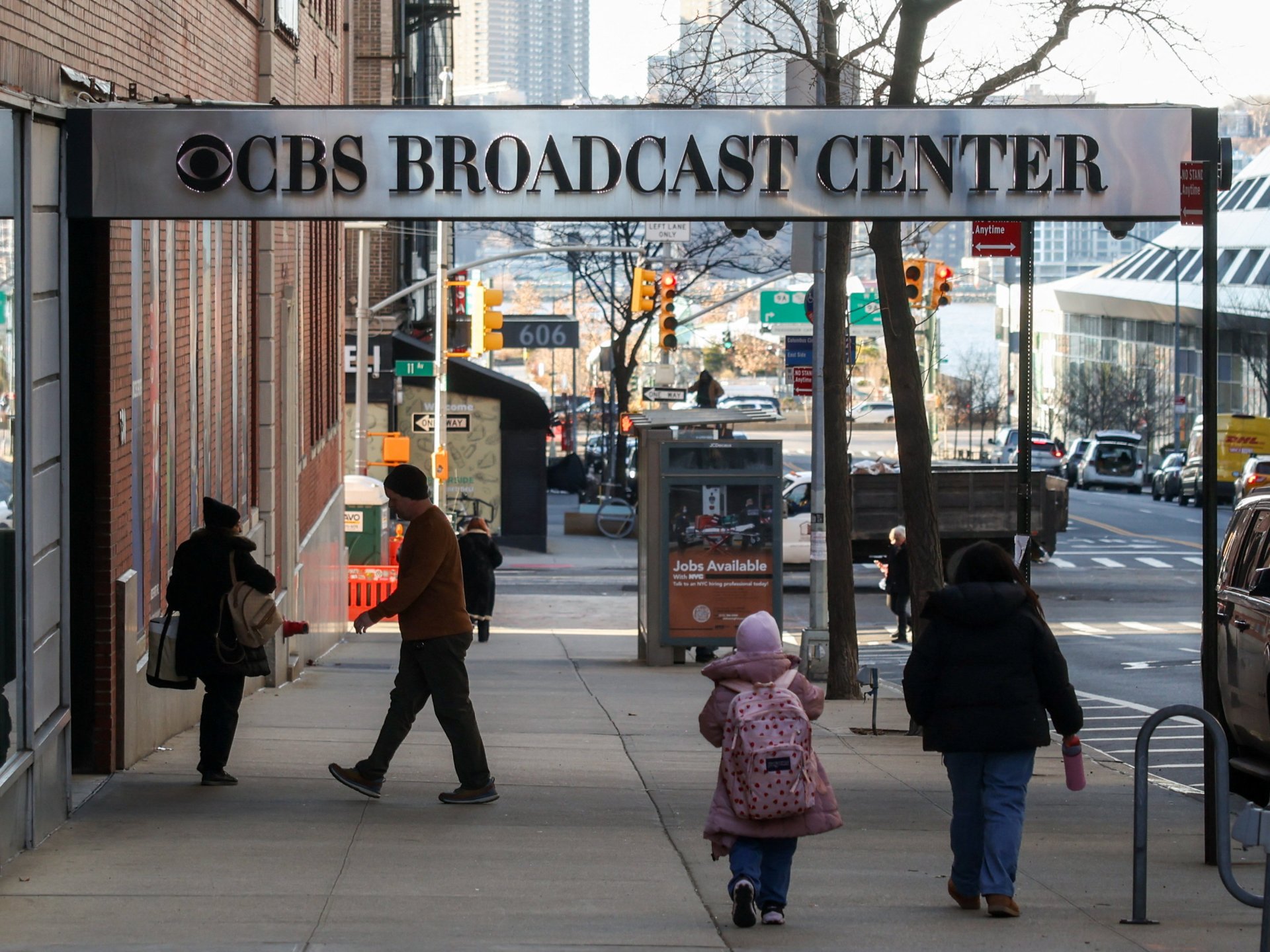
On Thursday, Warner Bros Discovery shareholders are set to vote on a merger that could dramatically reshape the United States media landscape — combining the company with Paramount Skydance.
The deal, which still needs to be approved by federal regulators, would place two of the nation’s largest news organisations – CBS News and CNN – under one roof.
Recommended Stories
list of 4 itemsend of list
Earlier this month, the independent proxy investor advisory Glass Lewis urged investors to vote in favour of the merger.
Paramount Skydance is led by David Ellison, the son of Oracle co-founder Larry Ellison, who is a key ally of US President Donald Trump. Under Ellison’s leadership, the network has already taken steps, critics say, to appease Trump.
Those moves include appointing conservative opinion writer Bari Weiss, who has no prior television experience, to lead the storied broadcast network; installing Ken Weinstein, a former Trump administration appointee, as an ombudsman tasked with policing bias; and delaying or spiking stories critical of the administration – including the delay of publishing a story on CECOT, the notorious El Salvadorian mega prison to which the Trump administration deported Venezuelan migrants. Sharyn Alfonsi, the reporter who covered the story, called that move a “political” choice.

But the deal has faced continued regulatory scrutiny. Last month, Democratic US Senator Cory Booker of New Jersey called Federal Communications Commission Chair Brendan Carr to investigate foreign investment in the merger, which includes the sovereign wealth funds of Saudi Arabia, Qatar, and the United Arab Emirates as well as investment from China.
Across the pond, the Competition and Markets Authority (CMA), Britain’s antitrust watchdog, is set to launch an investigation into the looming deal, Reuters news agency reported.
Even before the merger, some longtime reporters, including justice correspondent Scott McFarlane, have been “disillusioned with the overall direction” at CBS under the direction of Ellison and Weiss and moved on, industry trade publication Status reported.
Amid other major changes at the network, CBS announced last month that it would cease operations for CBS News Radio, which represents 6 percent of its workforce.
If the merger proceeds, CNN would fall under the same corporate umbrella. CNN, viewed by Trump as overly critical, has frequently been a target of his attacks. Ellison has reportedly promised Trump “sweeping changes” at the network if the deal is completed.
CNN has long been the middle-of-the-road network, compared to MS Now, formerly known as MSNBC, on the left and Fox News, which caters to the right.
Internally at CNN, the looming merger is fuelling concern about what the future of the network looks like, with reports that staffers were “shaken” by the possibility of the Ellisons running the cable network.
Last month, Paramount’s Ellison appeared on CNBC to quell concerns that CNN’s editorial stance would change under him, saying that editorial independence “needs to be maintained”, adding in the interview that “it’s maintained at CBS”, a claim refuted by press freedom experts.
“Ellison has already shown his cards when it comes to editorial independence and has zero credibility on the issue,” Seth Stern, director of advocacy at the Freedom of the Press Foundation, told Al Jazeera.
“Ellison may not turn CNN into Fox News overnight and may even still let CNN reporters criticise Trump at times. But it’s a virtual certainty that when his business interests are at stake, Trump will be given a seat at the editor’s desk.”
Emerging partisan bias
These concerns are underscored by a comparable merger happening in the local news ecosystem, where partisan bias is generally less overt.
The merger in question is between two of the largest local affiliate operators in the US — Nexstar and Tegna. Mirroring concerns about the possible merger between CNN and CBS News’s parent companies, the combined Tegna and Nexstar could consolidate and limit access to differing viewpoints, especially as this merger would reach 80 percent of TV households across key US markets.
While individual networks, including ABC, CBS, NBC and FOX, have their own editorial stances, local news stations affiliated with them do not necessarily share those.
There are roughly 250 ABC-affiliated news stations in the US, but only eight of them are actually operated by ABC’s parent company, Disney. This is comparable across other networks. CBS only operates 17 of its stations. Fox operates 29, NBC operates 11, but they all have affiliated stations in more than 200 markets.
The companies that operate affiliated stations that are not owned and operated by networks include Sinclair, Tegna and Nexstar as well as their competitors, including Gray Media, Scripps, Hearst TV, Allen Media Group and Graham Media.
Under this model, a TV station produces its own content including news programming tailored to its local audience. It then licenses national network content to fill the rest of its schedule, such as national newscasts, talk shows, sitcoms, sports, and other programming. The station and the network share the advertising revenue.
For networks, this arrangement allows them to reach audiences across the country without owning broadcast infrastructure in every market. For local affiliates, it provides access to higher-profile programming that attracts larger audiences and supports stronger advertising revenue.
Historically, local news operators did not take part in the partisan media ecosystem. But that has started to shift, starting with right-leaning Sinclair Broadcast Group, which owns stations in 85 different markets, including the ABC station in Washington, DC and the NBC station in Providence, Rhode Island.
In 2018, the company gained notoriety for its right-wing stance and for forcing anchors across all of its markets to read a script pushing Trump’s talking points on the state of the US media, using the same script across nearly 200 stations.
Now Nexstar, which operates its own cable network called NewsNation, and which was originally positioned as unbiased, is staffed up with former Fox personalities and trending right, Status reported.
Limited news options for local consumers
Mergers of local news operators have faced antitrust scrutiny in the past. In 2018, the US Federal Communications Commission (FCC) effectively blocked a looming merger between Tribune Media and Sinclair — the then-largest affiliate operator in the US — by sending it into a lengthy regulatory review, and called for the companies to divest in stations they owned.
Instead, Tribune pulled out of the deal, only to later merge with Nexstar to make the largest operator, bypassing Sinclair.
The $6.2bn Tegna-Nexstar merger was approved by shareholders in November and has the blessing of the US president.
“We need more competition against THE ENEMY, the Fake News National TV Networks”, Trump said in a post on Truth Social, his social media platform, in February.
In March, eight state attorneys general, including those for New York, California, Illinois, North Carolina and Virginia, filed a lawsuit to block the merger. The next day, the FCC approved the merger. In response, the coalition of state AGs filed an emergency motion to stop it.
Carr, the FCC chairman, who would otherwise be involved in the regulatory scrutiny of a deal like this, reposted Trump’s Truth Social post on X.
The deal is currently on hold as a federal judge in California issued a temporary restraining order to block the merger while it considers the antitrust lawsuit.

