


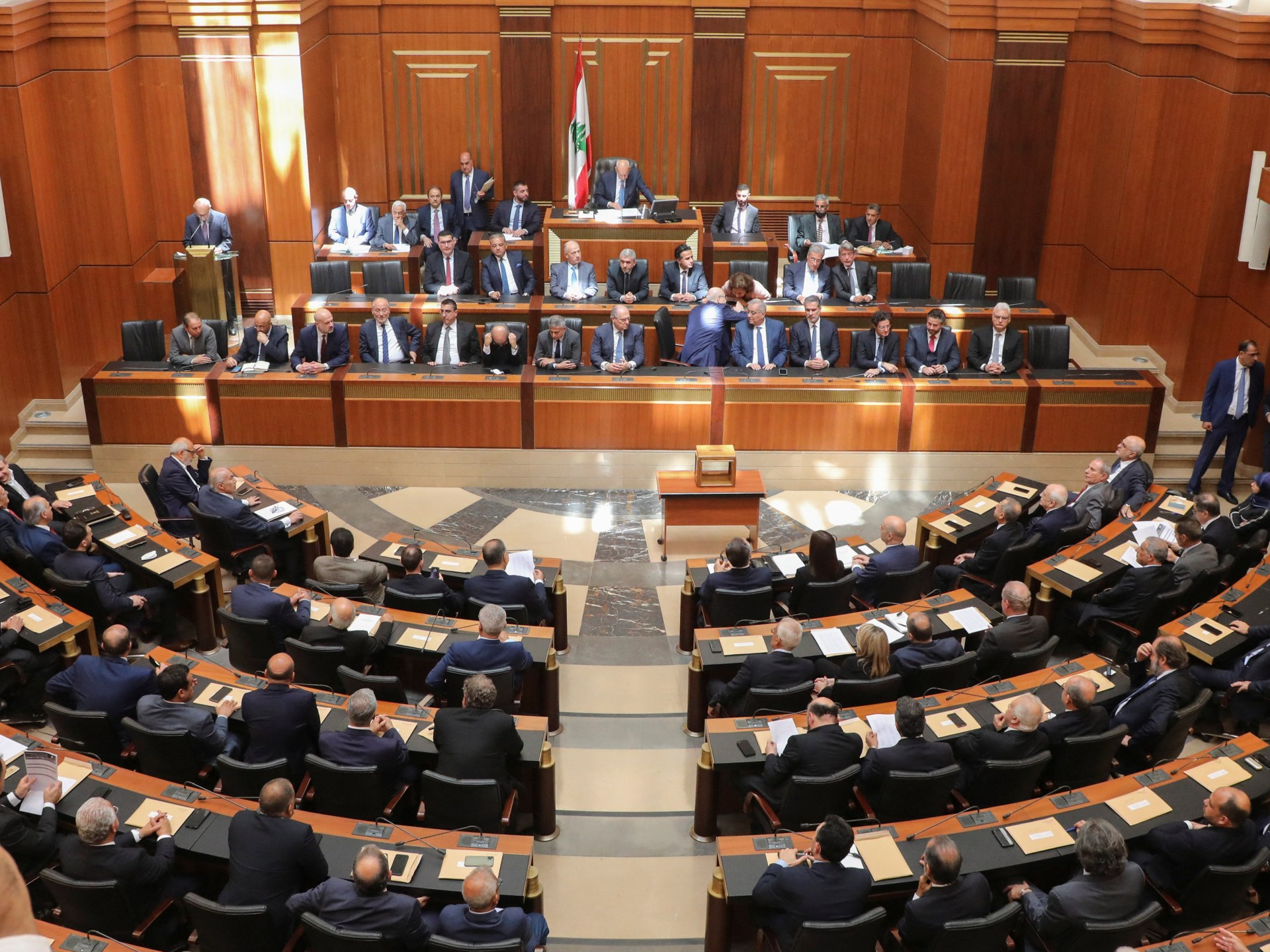
Hezbollah is the most prominent of Lebanon’s political movements, and has long been the most powerful in the country.
Its current battle with Israel means it has a huge say in the future of the country, but also places it at the centre of a debate with other political groups in Lebanon, many of whom feel that Hezbollah should be subservient to the state.
Recommended Stories
list of 3 itemsend of list
Lebanon’s sectarian divides are reflected in the large number of political movements it harbours, and the difficulty any government has in forming a strong power centre that will enable the country to overcome the various political, security, and economic crises it faces.
Here is a closer look at some of Lebanon’s most important political movements.

Hezbollah
Led by Secretary-General Naim Qassem, Hezbollah was formed in 1982 during the Lebanese Civil War (1975-1990) and subsequent Israeli occupation of southern Lebanon (1982-2000). Since its inception, Hezbollah has been funded by the Islamic Republic of Iran and has close ties to the Islamic Revolutionary Guard Corps (IRGC).
Originally an offshoot of the Amal Movement, Hezbollah grew to become the most powerful party – politically and militarily – in Lebanon. It is a religiously conservative Shia Muslim party that, like many parties or political leaders, also provides social services in the absence of the Lebanese state.
Hezbollah was the only militia not to officially disarm at the end of the civil war, arguing that it needed to maintain arms to oppose Israel’s then occupation of southern Lebanon. In 2000, it secured its most important win, as it was a key actor in expelling Israel from Lebanese territory.
But Hezbollah retained its weapons and fought a notable war against Israel in 2006, as well as since October 2023, when it launched attacks in solidarity with Palestinians in Gaza.
After an Israeli intensification in 2024 that killed much of Hezbollah’s military leadership, including its longtime leader Hassan Nasrallah, and the fall of the group’s ally Bashar al-Assad in Syria, Hezbollah was widely considered weakened, and the Lebanese government began efforts to disarm Hezbollah, aiming to establish a monopoly on arms in the country. Hezbollah has resisted, saying it needs to continue to defend Lebanon from Israel.
After the conclusion of the civil war, Hezbollah entered politics, with members running for office in Parliament. It has had spells in Parliament in both as part of a majority government and as the opposition, but it has also used its power to secure influence within Lebanon’s security apparatus.

Lebanese Forces
The Lebanese Forces (LF) is currently the largest Christian party in Lebanon’s parliament.
A right-wing nationalist Christian party, the Lebanese Forces formed during the country’s civil war under Bashir Gemayel. Gemayel was controversially elected Lebanon’s president in 1982, but was assassinated before he could take office.
The LF emerged from the Kataeb Party, founded by Gemayel’s father, Pierre. Today, the Kataeb still exists and is led by another member of the Gemayel family, Samy. While the LF has overtaken the Kataeb as the more significant political player, the two parties still collaborate and are fairly closely aligned politically.
Today, the LF is one of Hezbollah’s staunchest critics and adamantly opposes the group’s arms and war against Israel.
The party’s leader is Samir Geagea, who made his name as a militia leader during the civil war. He went on to spend 11 years in solitary confinement and was only released after the end of the Syrian occupation of Lebanon (1976-2005).
The LF was a key member of the pro-West March 14 bloc, named for the day of the largest protests in 2005 against Syrian occupation in Lebanon. It currently has four ministers in the Lebanese government.

Future Movement
Founded as a coalition in 1995 by the assassinated Prime Minister Rafik Hariri, the Future Movement became an actual party in 2007, two years after Hariri’s death.
At its peak, the Future Movement was also a multiconfessional bloc comprising mostly Sunni Muslims and Christians of different denominations, and was the heart of the pro-West and pro-United States March 14 bloc with the Lebanese Forces. In recent years, it has lost members and is now considered a predominantly Sunni party.
The party is today led by Hariri’s son, Saad, who is also a former prime minister.
Hariri had withdrawn from politics in 2022, and the Future Movement didn’t officially run any candidates that year. But in 2026, Saad announced that the Future Movement would return to politics whenever the next parliamentary elections take place.
The Future Movement’s base is largely in Sunni populations in the major coastal cities, such as Sidon and Beirut. It also has support in Sunni-majority areas of northern Lebanon outside Tripoli, such as Akkar.

Amal Movement
A key Hezbollah ally, the Amal Movement is also a predominantly Shia Muslim party and, along with Hezbollah, makes up what is known locally as the Shia Duo. The party, however, has a less overtly religious identity.
Amal was cofounded by Musa Sadr, a revolutionary Iranian-born Shia leader, and Hussein al-Husseini, a former Lebanese speaker of parliament, as the Movement of the Deprived. Amal, which means hope in Arabic, was the acronym of the Movement’s militia name in Arabic, the Lebanese Resistance Regiments.
Since 1980, the group has been led by Nabih Berri, who is also the country’s parliament speaker since 1992. Berri is often seen as a conduit to Hezbollah. Countries that do not have relations with Hezbollah reportedly pass messages through Berri.
At 88, Berri has been rumoured to be ill for years, and the question about his successor and the future of the Amal Movement, which has no stated successor, is unclear.
The party, which is popular in parts of Beirut, its southern suburbs, the southern city of Tyre, and other parts of the south and Bekaa Valley, currently has two ministers in government.

Free Patriotic Movement
The Free Patriotic Movement (FPM) was founded in 1994 by former President and Lebanese Army Chief Michel Aoun, while he was in exile in Paris.
Aoun returned to Lebanon in 2005 after the end of the Syrian occupation and soon after allied with Hezbollah and Amal to form the March 8 Alliance. At its peak, the FPM had a strong multiconfessional parliamentary presence.
However, in recent years, the FPM has lost support and has become a predominantly Christian party.
After Aoun took over the Lebanese presidency in 2016, his son-in-law, Gebran Bassil, took over leadership of the party. Bassil is currently under US sanctions for corruption.
The FPM currently has members in Parliament but no ministers in government, though it has taken part in many past governments. It currently considers itself as an opposition voice to the current government.

Progressive Socialist Movement
Founded by Kamal Jumblatt in 1949, the Progressive Socialist Party is a predominantly Druze party and was a key participant in the Lebanese Civil War.
Jumblatt was a key figure in the Lebanese National Movement, a left-wing and pro-Palestinian movement, prior to the civil war and advocated for a secular society. Jumblatt was reportedly assassinated in 1977 on the orders of Hafez al-Assad, then president of Syria. Jumblatt was succeeded by his son Walid as leader of the party and the group’s militia.
Walid led the party until 2023, when he handed power over to his own son, Taymour. Walid, however, is still regularly visited and consulted by political contacts and international diplomats.
Under Walid, the party has, at times, come into alliance with Hezbollah, but has also aligned with the pro-West March 14 bloc.
The party currently has two ministers in government. Its support is mostly found in Druze villages in Mount Lebanon.

