


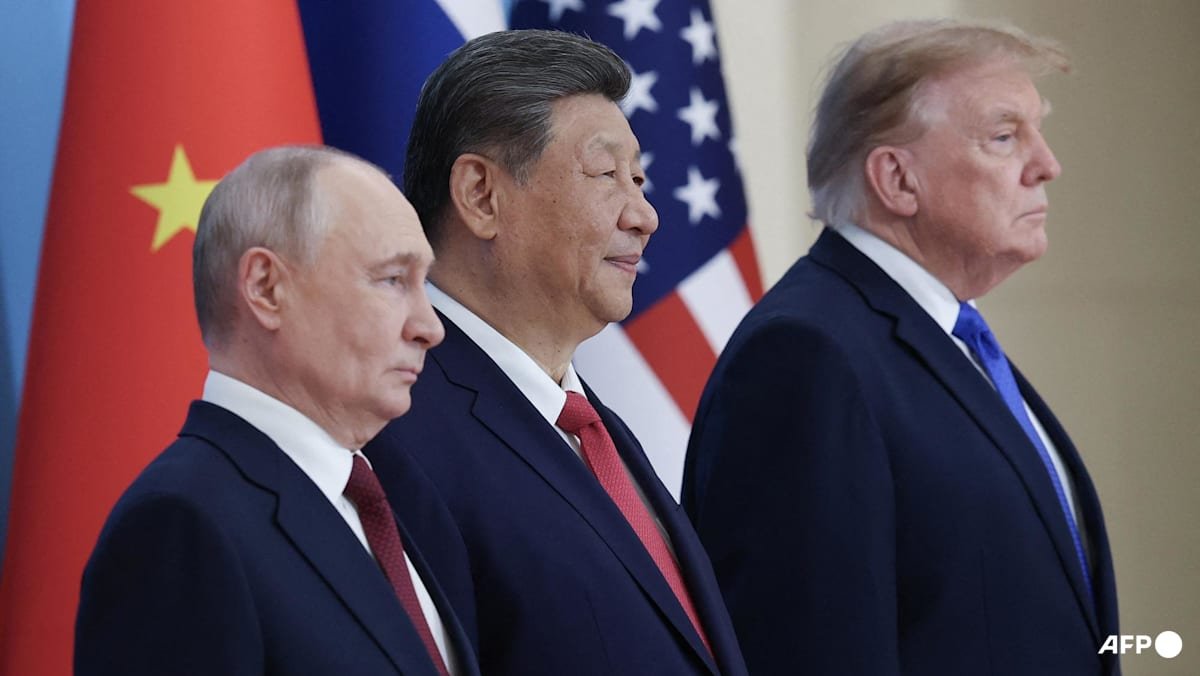
Putin appeared keen to sustain the diplomatic momentum.
At a news conference after the trilateral summit, he described the talks as “open” and “very useful” and said he wanted the format to continue.
The leaders had achieved “if not an agreement, then mutual understanding” across several key areas, he said.
But the diplomatic gains offer little indication of how far they are prepared to go in addressing their differences, Wang said.
“In practice, these top-level principles will be hard to translate into details,” she cautioned.
DEFUSING NUCLEAR RISKS
Experts said talks to reduce nuclear risks were the most realistic near-term outcome.
In their declaration, the leaders reaffirmed that “a nuclear war cannot be won and must never be fought” and pledged further dialogue on non-proliferation.
However, they stopped short of committing to cuts in their nuclear arsenals or launching formal three-way arms-control negotiations.
Wu Xinbo, professor and dean of Fudan University’s Institute of International Studies and director of its Center for American Studies, said the outcome was in line with China’s expectations.
“The United States and Russia … should first make substantial nuclear reductions,” he told CNA.
“If they do not take the lead in making substantial cuts, China cannot take such a step, he said, echoing China’s long-standing position.
According to estimates by the Stockholm International Peace Research Institute, China has about 620 nuclear warheads, compared with 5,042 held by the US and 5.420 by Russia.
Regardless, the commitment to talks on nuclear security is “significant and positive”, said Daniel Salisbury, a senior fellow for nuclear arms control, non-proliferation and disarmament at the International Institute for Strategic Studies (IISS), a London-headquartered security think-tank.

