


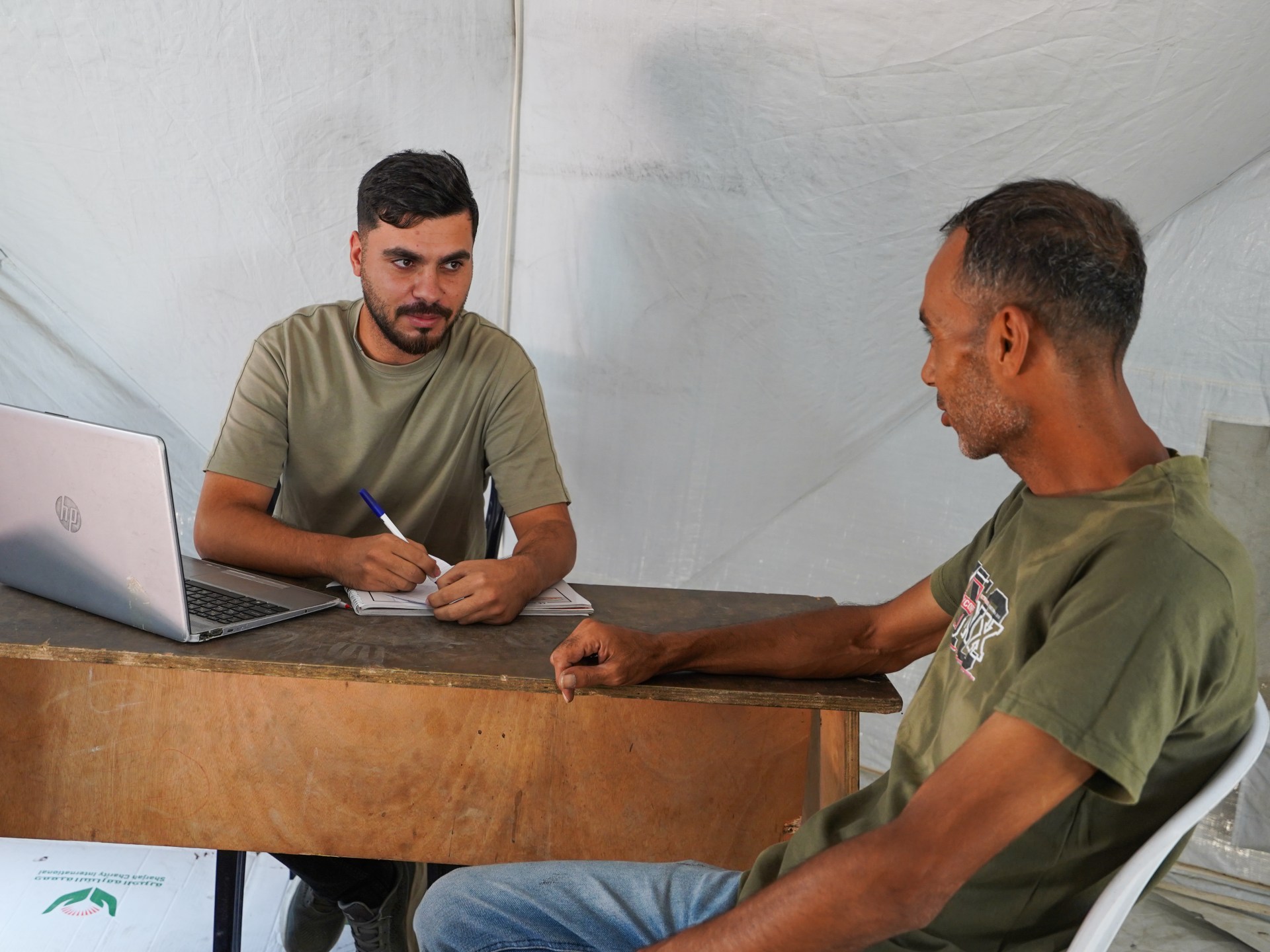
Khan Younis, Gaza – Dr Mohammed al-Khalidi, a specialist in prosthetics and orthotics, sits in a modest tent in al-Mawasi, southern Gaza. It has been his place of work since his clinic on al-Bahr Street in Rafah was destroyed by Israeli bombing in April 2024. His second and third clinics in Khan Younis’s Old City, southern Gaza, were subsequently destroyed by Israel in May 2025.
After this triple heartbreaking setback, al-Khalidi salvaged whatever medical equipment he could find and moved into his new office, a tent, where he has received patients for the past two years.
Recommended Stories
list of 3 itemsend of list
This transitory space reflects a new reality in Gaza since Israel’s genocidal war on the enclave began in October 2023. Offices, clinics and shops have been wiped out in waves of Israeli air raids over the past three years, leaving professionals to conduct their work from tents or on the road.
This phenomenon emerged in December 2023 following the displacement of Khan Younis residents to a narrow strip of coastal land between their hometown and Deir el-Balah.
After a ceasefire, repeatedly broken by Israel, was announced for the enclave in October 2025, more of these tent offices, surgeries and shops emerged across Gaza as professionals sought to continue their practices.
Challenges
Working within these canvas confines presents multiple challenges for al-Khalidi. There is limited space, unreliable electricity, and the intense heat and loud noises to deal with.
The setting bears little resemblance to his previous practice in a bricks-and-mortar office, but he still feels this arrangement is better than suspending services altogether.
There is a massive need for prosthetics in Gaza, where between 5,000 and 6,000 people have undergone amputations between October 2023 and October 2025.
“Working from a temporary space is nothing like working in a fully equipped clinic, but for me, it is better than stopping the service altogether,” al-Khalidi told Al Jazeera.
“Patients who need prosthetic limbs or orthotic devices cannot always wait until conditions return to normal. Some have lost a limb during the war, while others need follow-up care or adjustments to devices they rely on in their daily lives.”
![Dr Mohammed Al-Khalidi, a specialist in prosthetics and orthotics, continues to work from inside a tent after his private clinic was destroyed during the war October 6, 2026 [Iyad Al-Qatrawi/Al Jazeera]](https://www.aljazeera.com/wp-content/uploads/2026/10/1-1791622989.jpeg?w=770&resize=770%2C633&quality=80)
More than four-in-five buildings in Gaza have been damaged or destroyed since Israel’s genocidal war began in 2023, according to the Palestinian Central Bureau of Statistics (PCBS), creating a real estate crisis.
The lack of office space has seen rental prices reach unaffordable levels for most Gaza professionals. But resilience, necessity, and duty have encouraged Palestinians to find solutions to this situation. Tents are now where lawyers meet clients, doctors treat patients, and traders sell their wares.
Repeated displacement
After Omar al-Tawashi, a civil engineer and construction auditor, saw his office destroyed in an Israeli air strike in August 2024, he began work from his home in July 2025. But that too met the same fate, so he shifted operations to a tent in Deir el-Balah, central Gaza, to continue his work.
“My move to a tent was not a professional choice. It was a direct result of the destruction of the place where I used to work, compounded by the rental crisis, which made finding an alternative office extremely difficult,” he said.
“In some cases, rents have risen to more than 10 times their pre-war levels, making a new office beyond my means”.
The tent is not a suitable environment for his engineering work, but there is no alternative for al-Tawashi.
“There is heat, cold and noise, and none of the privacy needed when discussing projects or reviewing technical files,” Omar said. “But stopping work would mean losing my source of income”.
In the crowded market in Nuseirat camp, central Gaza, accountant Mahmoud Shaheen receives clients inside a small tent amid the sound of neighbouring vendors and passers-by.
Shaheen was once responsible for a Gaza-based company’s accounts, but the office was destroyed in an Israeli air strike in November 2025.
“Moving to a tent was not so much a professional choice as a response to a reality imposed by the war,” he told Al Jazeera.
With the start of the new school year in Gaza last month, tents have been pitched across the country as substitutes for schools destroyed in Israeli air raids or converted into refuges for the displaced.
School starts
Teacher Palestine Hussein has been forced to adapt to this new reality. She previously taught English at an educational centre in Bureij in central Gaza, which she had spent years building.
It was destroyed in seconds when an Israeli air raid destroyed the educational facility, so she now teaches children from a tent at al-Balata, a camp for displaced Palestinians in Nuseirat.
![Teacher Falasteen Hussein: “The tent represents an attempt to hold on to what remains of my profession, rebuild my dream and preserve my source of income, even with the most basic resources.” October 6, 2026 [Iyad Al-Qatrawi/Al Jazeera]](https://www.aljazeera.com/wp-content/uploads/2026/10/2-1791622997.jpeg?w=770&resize=770%2C513&quality=80)
There is a lack of seats for the students, ventilation, or protection from the noise and heat. But despite these challenges, Hussein is determined to provide children in the camp with some form of education.
“Although the tent may appear to be a temporary place, to me it represents an attempt to hold on to what remains of my profession and rebuild my dream from scratch, even with the most basic resources,” Hussein told Al Jazeera.
New reality
Trader Khalil al-Tahrawi saw his clothing store in Nuseirat destroyed by Israeli bombing in October 2023. After salvaging surviving merchandise from his destroyed shop, he displayed his goods – mostly men’s T-shirts and jeans – at a small tent in the Nuseirat market.
He pays $350 a month in rent for the small patch of pavement to sell the clothing, which he removes every night to protect them from thieves.
“This routine makes the work even more difficult and consumes my time and energy,” al-Tahrawi told Al Jazeera.
![Merchant Khalil Al-Tahrawi displays clothing in a small tent by the roadside in the Nuseirat market after his shop was destroyed during the war October 6, 2026 [Iyad Al-Qatrawi/Al Jazeera]](https://www.aljazeera.com/wp-content/uploads/2026/10/4-1791623015.jpeg?w=770&resize=770%2C513&quality=80)
Repeated power cuts, unreliable internet and shortages of equipment have complicated efforts by Gaza’s business community to rebuild during this period of a relative decrease in bombing.
Customers, too, are changing their consumption patterns, heading to certain towns or camps for a particular good or service. Often what they find are prices more inflated than during Israel’s siege on Gaza before Israel’s genocidal war.
One customer, Mohammed Zweid, a 24-year-old IT worker, looks through a market in Nuseirat. “Accessing professionals in tents and temporary spaces is better than having no service at all,” he told Al Jazeera. “The transformation has changed not only where services are provided, but also how they are experienced.”

