


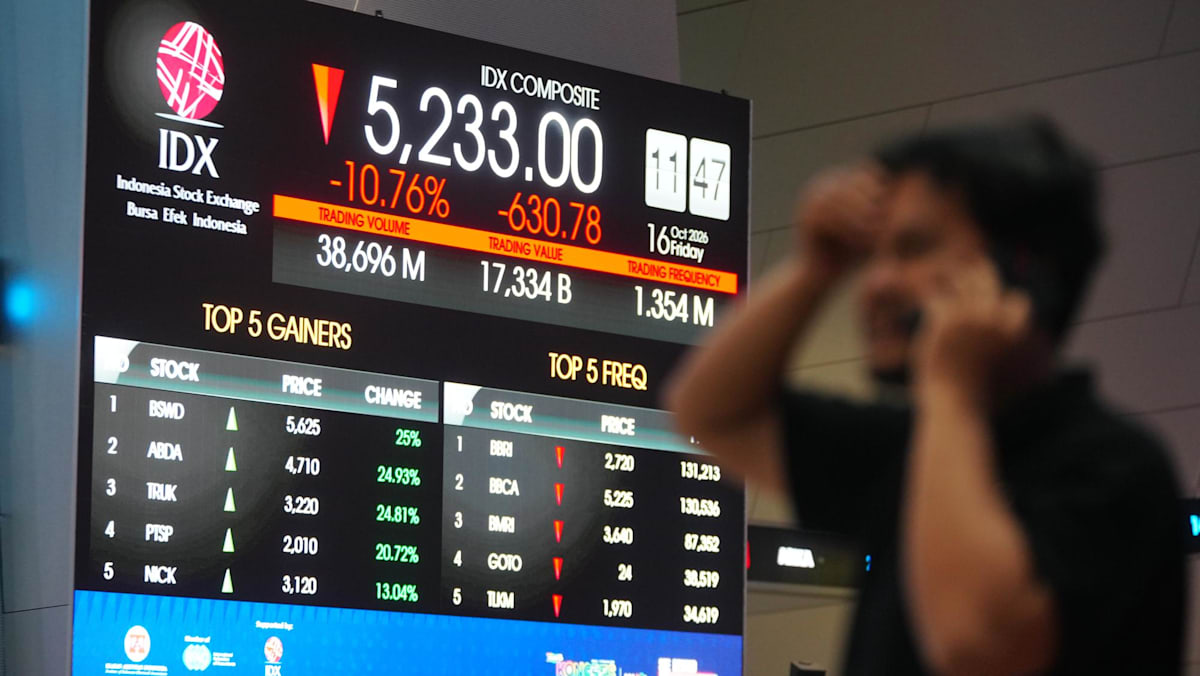
SINGAPORE: About US$65 billion was wiped off the value of Indonesian stocks on Oct 16 after global index provider MSCI proposed downgrading the country’s stock market from emerging market to “standalone” status.
The Jakarta Composite plunged 11.6 per cent following the announcement, marking its biggest one-day fall since the 1998 Asian financial crisis.
The proposal caught investors by surprise, as it went further than MSCI’s initial warning in January that Indonesia could be demoted to “frontier market” status.
If implemented, the downgrade could trigger billions of US dollars in foreign outflows from Southeast Asia’s largest economy, even as Indonesian authorities pursue reforms aimed at addressing concerns over market transparency and trading practices.
But the downgrade is not yet a done deal. MSCI has given Indonesia time to demonstrate meaningful and lasting improvements before reaching a final decision next year.
What does a standalone status mean, why is MSCI considering such a drastic downgrade, and how could it affect Indonesia’s stock market?
THE INFLUENCE OF MSCI
MSCI, originally known as Morgan Stanley Capital International, is one of the world’s largest index providers, alongside rivals such as FTSE Russell and S&P Dow Jones Indices.
Its influence lies in the widespread use of its benchmarks by global fund managers, who rely on them to guide investment allocations and measure the performance of their portfolios.
About US$10 trillion in assets are benchmarked against MSCI’s Emerging Markets Index, making its decisions on which countries and companies to include potentially consequential for investment flows.
A country’s inclusion in or exclusion from these indexes can therefore influence how much foreign capital enters or leaves its stock market.
WHAT A STANDALONE DOWNGRADE MEANS
MSCI classifies global equity markets into four categories: developed, emerging, frontier or standalone.
Frontier markets are smaller, less developed or less accessible than emerging markets.
To qualify, a market must have at least one company meeting MSCI’s minimum size and liquidity requirements, among other criteria, and demonstrate a degree of accessibility to foreign investors
Asian markets in this category include Vietnam, Pakistan, Sri Lanka and Bangladesh.
Standalone markets, meanwhile, sit outside MSCI’s developed, emerging and frontier market indexes.
They are broadly classified into two groups: newly eligible markets and markets previously classified under the developed, emerging or frontier market categories.
According to MSCI, a market may be reclassified as standalone if there is a severe deterioration in its accessibility, size or liquidity.
Markets in this category include Argentina, Lebanon, Nigeria and Ukraine. None are in the Asia-Pacific region.
For Indonesia, a downgrade from emerging to standalone status would mean its stocks being removed from major emerging market indexes tracked by investment funds worldwide.
Funds that passively track these indexes, or are ranked against them, would be forced to sell their Indonesian holdings. Actively managed funds benchmarked against them could also reduce their exposure.
If Indonesia’s market is downgraded to standalone status, it would become the largest economy in the standalone category, at more than twice the size of Argentina, the next largest.

