


An internal Canadian Armed Forces memo says the fire index was low for a scheduled live-ammunition training exercise Saturday at a base near Wainwright, Alberta, when an “unexpected and sudden wind change” sparked a runaway grass fire that killed four soldiers and seriously injured dozens more.

“During training, a grass fire ignited, and strong winds caused the fire to spread rapidly and shift direction; the fire shifted toward the personnel on the range and overtook their admin area,” the memo states.
Earlier on Saturday, Environment Canada had issued a high-wind warning for Alberta. Gusts of up to 100 km/h in some parts of the province tipped over semi-trailer trucks and toppled trees.
Issued Sunday by the Strategic Joint Staff (SJS) and obtained by Global News, the memo also said the fire jumped a fire guard and spread outside the base, forcing the evacuation of one family home. The fire has been contained but is still burning.
The SJS directly reports to the chief of defence staff, Canada’s highest-ranking military officer.

Get daily National news
Get daily Canada news delivered to your inbox so you’ll never miss the day’s top stories.
The staff memo specifies that the dead and injured are from C or Charlie Company, Third Battalion of the Princess Patricia’s Canadian Light Infantry, which is based at Edmonton Garrison.
Four soldiers were killed, another 31 suffered “very serious or serious” injuries, and six to eight others had minor injuries, it said.
Fifteen soldiers were intubated and sent to the University of Alberta and Royal Alexandra hospitals in Edmonton.
The memo cautioned that the situation was “fluid” and “these casualty reporting numbers are considered accurate but may change over time with ongoing assessments of casualty status.”
At a news conference Sunday afternoon, Maj.-Gen. Wade Rutland identified the four deceased as Sgt. Morgan Wong of Edmonton, and Privates Shaun Farrell of Prince Albert, Sask., Aidan Goulding of North Vancouver, B.C., and Hayden Lykkemark of Langley, B.C.
Their families have been notified.
Rutland said the training was to prepare the soldiers for a global response task force “ready to move within hours to any hotspot around the world,” and for deployment to Latvia in April and May to bolster the brigade there.
“This was high-intensity combat training with live munitions.”
Prime Minister Mark Carney told a news conference it was one of the worst tragedies on Canadian soil in peacetime.
“The nation is in mourning for those brave members of our armed forces who we have lost,” Carney said, adding that, to honour them, flags on all federal buildings will be flown at half-mast.
The Royal Canadian Air Force dispatched seven Griffon helicopters from Edmonton, and one Hercules aircraft from Winnipeg.
Ten search-and-rescue technicians parachuted from the Hercules onto a field in Wainwright, a town of about 6,500 people, about 200 km east of Edmonton, near the Saskatchewan border.
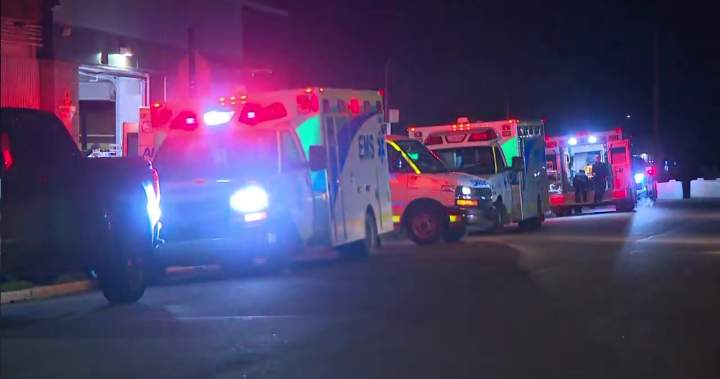
The non-profit charity, STARS, or Shock Trauma Air Rescue Service, dispatched air ambulances from Edmonton and Saskatoon, and nearby towns sent ground ambulances to assist in the transfer of the injured.
Investigators with the Canadian Forces National Investigation Service are en route to Wainwright, and the RCMP have offered investigative support, the memo states, adding that the process of casualty confirmation and next-of-kin notification has begun.

